Battlegrounds by H. R. McMaster
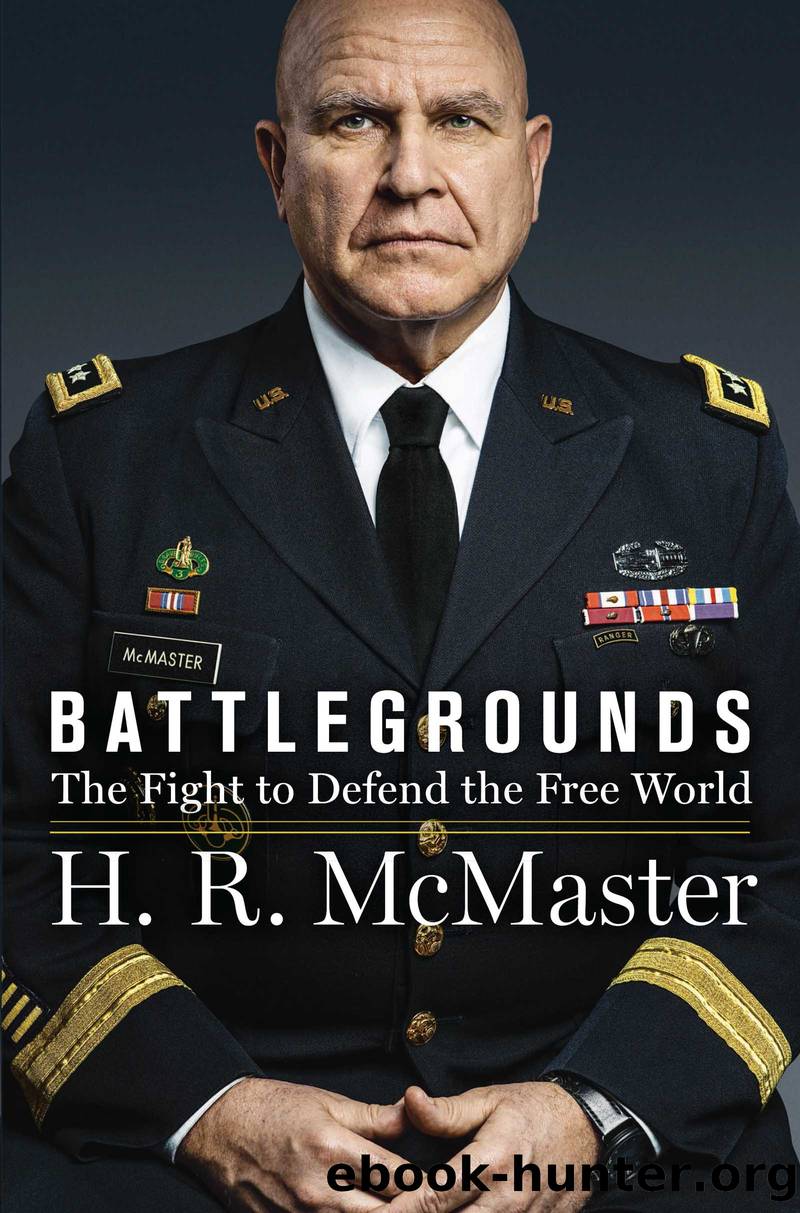
Author:H. R. McMaster
Language: eng
Format: epub
Publisher: Harper
Published: 2020-04-06T00:00:00+00:00
Chapter 10
Forcing a Choice
Anyone who will say that religion is separate from politics is a fool; he does not know Islam or politics.
âKHOMEINI
IT WAS harder than it should have been to implement the Iran policy announced in President Trumpâs October 2017 speech. Any policy shift is difficult across all departments and agencies of the U.S. government, especially when the change in direction is significant, as with Iran. And some of the friction in implementation was due to lingering sympathy for a conciliatory policy. I believed we had to force Iran to choose between either acting as a responsible nation and enjoying the corresponding benefits of such behavior or suffering sanctions and isolation as it continued to wage its destabilizing proxy wars. But some continued to prioritize avoiding confrontation with Iran over forcing that choice, clinging to the forlorn belief that one day Iranian leaders would, as President Obama had hoped, unclench their fists.1
During the summer and fall of 2019, about a year after the United States withdrew from the Iran Nuclear Deal, and as Iranian oil exports and the value of its currency hit historic lows, Iran attacked Saudi, Emirati, Japanese, and Norwegian oil tankers; conducted drone strikes on Saudi Arabian oil facilities; and shot down a U.S. drone.2 Those actions should have confirmed to the United States that until there is an evolution in the nature of the regime, Iranian leaders will not abandon their proxy wars. Iranian aggression might also have disabused U.S. allies still supporting the JCPOA of the premise that the West can, through engagement and economic enticements, convince the regime to forgo aggression. What became known as the Gulf Crisis of 2019 reinforced the notion that the ideology of the revolution drives Iranâs external actions. Iranâs revolutionaries do not want to be conciliated, and Iran believes it can continue to have it both ways: use extra-state violence to achieve its objectives and still be treated internationally like a responsible nation. It was probably encouraged in this by the international reaction to its hostile acts, which assigned blame more to the U.S. withdrawal from the Iran Nuclear Deal than to the decisions made by Supreme Leader Ayatollah Khamenei, the Guardian Council, or IRGC commanders. âAmerica made Iran do itâ was the subtext behind too much news analysis.
But the regimeâs âGreat Satan,â âDeath to Israel,â and âDeath to Americaâ language is not mere bluster. Hostility toward the United States, Israel, and the West is foundational to Iranâs revolutionary ideology, but has historical roots that well predate the revolution. Iranâs leaders deeply resent colonial and foreign powers who are seen as the cause of the Persian empireâs collapse and their countryâs loss of sovereignty in the nineteenth and early twentieth centuries. Due to its strategic geography and oil reserves, Iran was an arena of competition in the âGreat Gameâ between Britain and Russia for power and influence across Central Asia. But Iran was also an active player in that game. In the 1930s, for example, authoritarian ruler Reza
Download
This site does not store any files on its server. We only index and link to content provided by other sites. Please contact the content providers to delete copyright contents if any and email us, we'll remove relevant links or contents immediately.
| Anthropology | Archaeology |
| Philosophy | Politics & Government |
| Social Sciences | Sociology |
| Women's Studies |
The Secret History by Donna Tartt(19479)
The Social Justice Warrior Handbook by Lisa De Pasquale(12297)
Thirteen Reasons Why by Jay Asher(9134)
This Is How You Lose Her by Junot Diaz(7061)
Weapons of Math Destruction by Cathy O'Neil(6483)
Zero to One by Peter Thiel(5955)
Beartown by Fredrik Backman(5951)
The Myth of the Strong Leader by Archie Brown(5632)
The Fire Next Time by James Baldwin(5592)
How Democracies Die by Steven Levitsky & Daniel Ziblatt(5335)
Promise Me, Dad by Joe Biden(5238)
Stone's Rules by Roger Stone(5196)
A Higher Loyalty: Truth, Lies, and Leadership by James Comey(5092)
100 Deadly Skills by Clint Emerson(5032)
Rise and Kill First by Ronen Bergman(4908)
Secrecy World by Jake Bernstein(4894)
The David Icke Guide to the Global Conspiracy (and how to end it) by David Icke(4854)
The Doomsday Machine by Daniel Ellsberg(4631)
The Farm by Tom Rob Smith(4614)
